

Across worship spaces worldwide, projection screens are steadily giving way to bright, seamless LED walls. Yet many church committees still buy on instinct - and end up with an image that washes out under stage lighting or blurs from the back pews. The good news is that both mistakes are avoidable. Ask the seven questions below before you sign any quotation, and the display you choose will serve Sunday services, midweek studies, and community events for a decade or more.
Why Worship Spaces Are Switching to LED
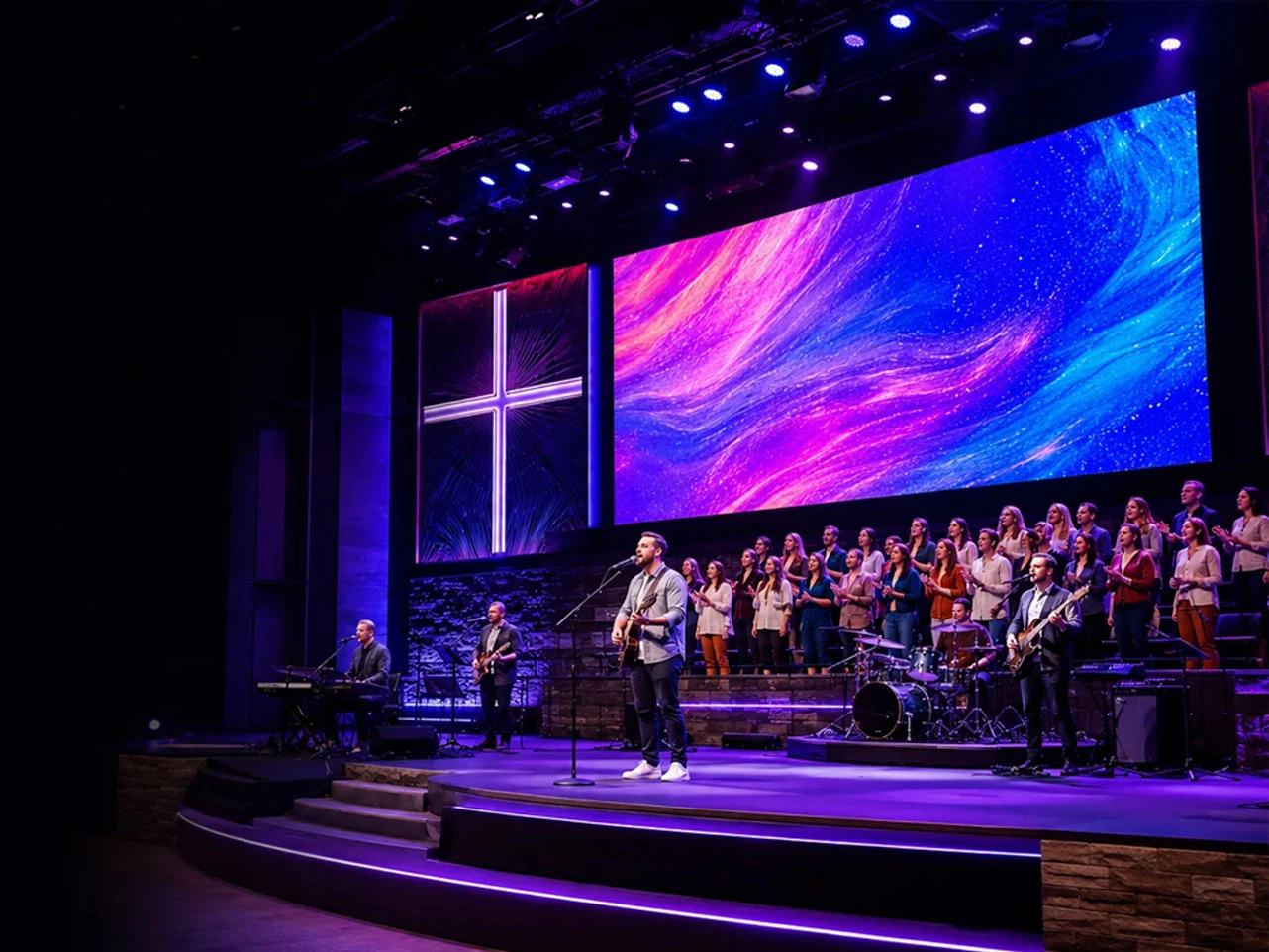
Houses of worship have quietly become one of the fastest-growing segments in the fine-pitch LED market. The reasons are practical rather than fashionable. A church LED wall produces no fan noise, casts no shadows across the screen, and needs no lamp replacements. Moreover, it stays readable with house lights fully on - a known weakness of projection. As visual worship, livestreaming, and hybrid services become standard, displays that look equally good in the room and on camera now matter more than ever.
The 7 Questions That Decide Your Project
1. How Far Will the Congregation Sit?
Pixel pitch - the gap between LED clusters in millimeters - should match seating distance first. As a working rule, viewers need roughly 1 meter of distance for every millimeter of pitch. Use the table below as a starting point:
| Pixel Pitch | Comfortable Viewing Distance | Typical Church Application |
|---|---|---|
| P1.5–P1.8 | Under 5 m | Chapels, close wall mounts |
| P2–P2.5 | 5–10 m | Mid-size sanctuaries |
| P2.6–P3.9 | 8–15 m | Large sanctuaries, stage backdrops |
| P4+ | Beyond 15 m | Balconies, overflow foyers |
A tighter pitch costs more per square meter. Therefore, measure the farthest fixed seat before you shortlist anything else.
2. How Bright Is the Room - Really?
Indoor fixed installations typically run between 600 and 1,000 nits, which suits most sanctuaries. However, rooms with tall windows or aggressive stage lighting need extra headroom. Just as important, look for high grayscale performance at low brightness: worship often dims the screen for prayer and reflection, and a weak processor will lose detail in those dark scenes. Ask to see the wall dimmed, not only at full power, during any demo.
3. Where and How Will It Be Mounted?
Measure the wall before you fall in love with a screen size. Structural limits, cable routes, and acoustic panels all constrain the install. Next, decide between rear-service and front-service designs. If the wall sits flush against concrete or backs onto a choir room, front-service cabinets are essential - otherwise technicians cannot reach the modules at all. Lightweight die-cast aluminum cabinets, now standard across the rental industry, have also made large church installs noticeably simpler.
4. What Will You Show on It?
Lyrics and scripture are forgiving; live video is not. If your services include IMAG camera work or you plan to stream, prioritize a finer pitch and a refresh rate of 3,840 Hz or higher so cameras record clean images without banding. In addition, confirm the processor handles the content mix - many congregations run lyric software, video playback, and live feeds through the same wall in a single service.
5. Who Will Service It After Installation?
Every display eventually needs a module or power supply swapped. Before ordering, get clear answers on:
- Which spare modules, cards, and cables ship with the system
- Whether access matches the venue (front vs. rear)
- How remote monitoring flags a failing power supply before Sunday
- What training volunteers or staff will receive
A supplier who answers these four items in writing is usually one you can work with.
6. What Does It Truly Cost Over Ten Years?
The quotation is only the opening balance. Energy draw, spare parts, and serviceability shape the real total. For example, common-cathode designs cut power consumption noticeably - a trend now spreading from outdoor advertising into indoor installations - which lowers running costs and heat. Compare quotes on a ten-year horizon rather than on purchase price alone, and the cheapest offer rarely stays cheapest.
7. Can the Supplier Prove Quality?
Finally, ask how each screen is verified before it ships. A 72-hour aging test, module-level inspection records, and a written warranty covering modules and power supplies are reasonable, standard requests. Suppliers who volunteer this evidence tend to stand behind their products; suppliers who dodge it have answered your question anyway.
Conclusion: Ask First, Buy Once
Choosing a church LED wall is less about finding the biggest screen and more about matching seven answers to one building. Gather your sanctuary dimensions, seating depth, and lighting conditions, then send them to a manufacturer for a grounded recommendation instead of a generic price list.