

Choosing between an LED video wall and an LCD video wall feels harder than it should. Sales pages on both sides quote impressive numbers, yet few explain what those numbers mean for your actual room, budget, and audience. As a result, buyers often overpay for specifications they never use-or underbuy and regret it within a year. This guide cuts through the noise with 7 practical facts. Moreover, each fact links directly to a decision you will make during procurement, so you can turn it into a checklist for your next quotation review.
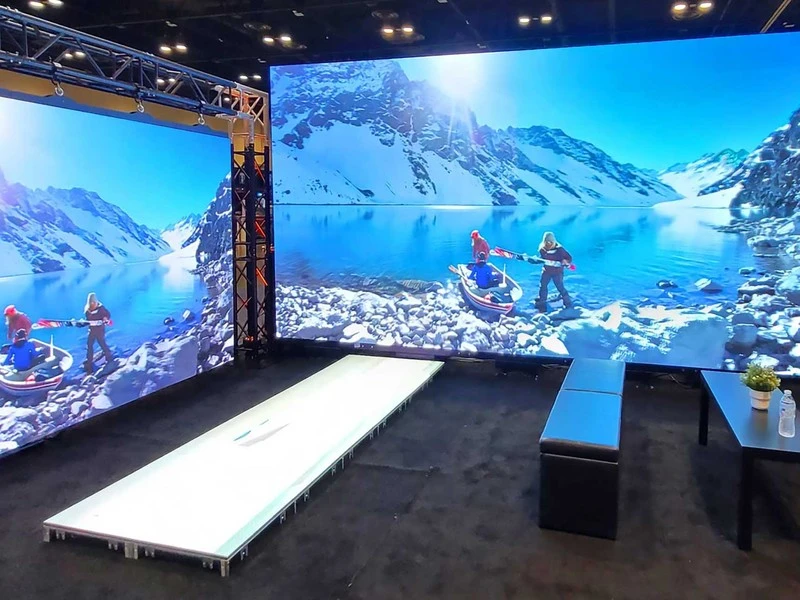
Fact 1: Seams Define the Viewing Experience
LCD panels form a video wall by tiling 55-inch units together. Even the finest bezel-to-bezel gap creates a visible grid, and that grid becomes distracting up close. LED video walls, by contrast, are built from cabinets whose modules abut with nearly invisible seams, so the image reads as one continuous canvas.
Practical rule: if viewers stand closer than roughly 3 meters, seams will show on LCD. In control rooms, retail flagships, and corporate lobbies, that alone often settles the debate.
Fact 2: Brightness and Ambient Light Behavior Differ
A commercial LCD video wall typically delivers 500–700 nits. An indoor LED video wall commonly runs 600–1,200 nits and adjusts dynamically, while outdoor-rated products exceed 5,000 nits. In addition, LED surfaces handle reflection better because there is no glass layer to bounce overhead lighting back at the audience.
| Scenario | Recommended Choice | Why |
|---|---|---|
| Dim control room | Either | LCD adequate; LED adds flexibility |
| Bright retail window | LED | Higher nits, anti-reflection |
| Sunlit lobby / storefront | LED | LCD washes out under sunlight |
| Conference room with blinds | Either | Budget decides |
Fact 3: Viewing Distance Sets the Pixel Pitch
Here is where LCD holds a real advantage: fixed resolution. A 55-inch LCD panel carries 1920×1080 pixels no matter what. LED, however, requires you to choose a pixel pitch-the spacing between LEDs. Sit too close to a P2.5 wall and you will see pixel structure; step back beyond the optimal distance and the image looks flawless.
Quick guide: divide the pixel pitch (in mm) by 0.3 to 0.8 to estimate comfortable viewing distance in meters. Therefore, a P1.5–P2.5 indoor LED wall suits rooms where people stand 3–6 meters away, which covers most boardrooms and event stages.
Fact 4: Structure and Installation Footprint
LCD video walls need a rigid, perfectly flat frame, and each heavy panel mounts precisely against its neighbors. LED cabinets are lighter per square meter, support curved and creative formats, and-on modern front-service designs-mount flush to a wall without rear access. Consequently, retrofitting an LED wall into an existing room is usually simpler than rebuilding the wall for LCD.
Fact 5: Power, Heat, and Operating Cost
LCD draws steady, predictable power. LED consumption scales with brightness: a common-cathode indoor wall can cut energy use by 30–40% versus older designs because power is delivered only where the image demands it. Furthermore, smart brightness sensors dim the wall at night automatically, which reduces both electricity bills and eye strain.
Fact 6: Maintenance Model Matters More Than MTBF
Every technology fails eventually; the difference lies in how you fix it.
- LCD: a failed panel means replacing a whole 55-inch unit-expensive, and stock must match.
- LED (front service): a technician removes one module from the front in minutes, without dismantling the structure or pulling the wall off the wall.
For 24/7 operations such as broadcast, security, and transport hubs, front-service LED design dramatically shortens downtime. Ask any supplier-ourselves included-for the module replacement procedure before signing.
Fact 7: Compare Lifetime Cost, Not Sticker Price
An LCD video wall usually wins on upfront price for small, standard formats. Over a 5–7 year horizon, however, the picture shifts: LED walls avoid seam upgrades, consume less power, tolerate partial repair, and hold resale value better for rental fleets.
| Cost Item (5 yrs) | LCD Video Wall | LED Video Wall |
|---|---|---|
| Initial hardware | Lower | Higher |
| Power consumption | Moderate | Lower (with common cathode) |
| Repair granularity | Whole panel | Single module |
| Format flexibility | Flat only | Flat, curved, creative |
| Long-term value | Static | Stronger |
So Which One Should You Buy?
Choose LCD when the budget is tight, the format is small and flat, and viewers stay far away. Choose an LED video wall when image continuity, brightness, creative shapes, or long-term operating cost carry weight-which describes most modern corporate, retail, broadcast, and stage projects.
Before you decide, verify three things with any manufacturer: real measured brightness (not just catalog numbers), front-service access, and a spare-parts package included with the shipment.