

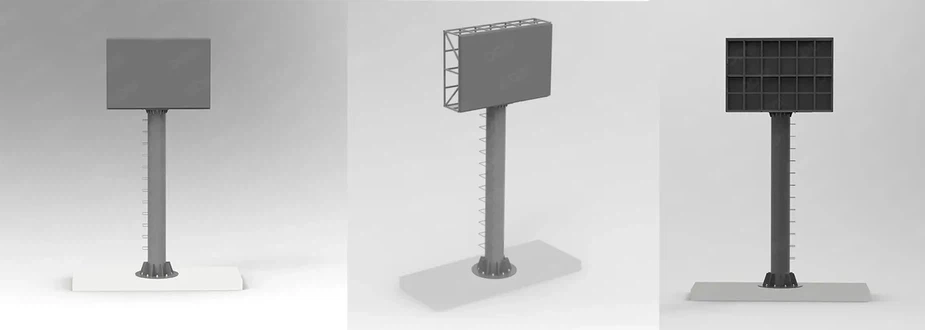
Before diving into the typical problems users encounter, it's important to understand the composition of an outdoor LED display. Although it functions as a unified screen, it is actually an integrated system made up of multiple components, including chips, power supplies, control systems, and various connection interfaces.
Key Components of an Outdoor LED Display
1.Cabinet: The fundamental structural unit of the LED display. Cabinets are assembled to form the full screen and can be customized in terms of material and size based on installation needs.
2.Chassis Frame: Supports and houses all internal parts of the cabinet, offering both protection and structure.
3.Power Supply: Converts AC from the main power grid into the appropriate DC voltage to drive internal components.
4.Receiving Card: Handles image data input and distributes the signal to each module within a cabinet.
5.Data Wiring: Facilitates communication between the receiving card and LED modules, as well as between cabinets.
6.Power Cabling: Delivers electrical power to each cabinet and ensures a stable connection across the whole display system.
With the advancement of unified control panels, it's now possible to individually inspect and test each section of the screen. This allows for targeted repairs without impacting the overall system performance.
Maintenance Challenge 1: Moisture Damage and Oxidation
Outdoor environments expose LED screens to humidity, rain, and temperature fluctuations. Moisture can seep through compromised seals or casings, potentially leading to component failure-commonly referred to as "dead pixels."
Although LED chips are typically sealed in epoxy resin for protection, prolonged exposure to harsh weather can degrade this protection.
To prevent such failures:
1.Inspect the display regularly, especially before and after bad weather.
2.Reapply protective coatings as needed on solder points and surfaces.
3.Repair or reseal damaged protective layers to prevent internal corrosion.
Maintenance Challenge 2: Visible Contour Lines in Low-Gray Areas
When viewing grayscale content, human eyes are particularly sensitive to subtle differences in brightness. If contour lines appear where the transition should be smooth, this is usually due to an inconsistency between the image's intended brightness and what the display actually outputs.
To resolve this issue:
1.Upgrade to 18bit+ grayscale technology, which enhances gradation smoothness, especially in darker tones.
2.Use image quality enhancement systems. These measure grayscale output using precision light meters, identify deviation points, and recalibrate the grayscale to achieve uniform transitions.
Maintenance Challenge 3: Color Deviation or Inaccurate Image Display
You may notice that colors displayed on a large LED screen sometimes look different from those on a computer or LCD screen. This discrepancy is often due to:
Differences in color gamut standards (e.g., BT.709 used in most content production).
Loose video signal connections or faults in the video processor.
To address color mismatches:
Perform color calibration using a light measurement gun to detect the screen's actual color output.
Apply color correction algorithms and image optimization engines to ensure consistent and accurate color rendering.
Final Thoughts on Maintenance and Longevity
Regardless of whether your LED screen is installed indoors or outdoors, routine maintenance is crucial. Here's what should be included in a standard maintenance checklist:
1.Hardware Inspection: Ensure all cabinet components are securely fastened. Replace any damaged or malfunctioning parts promptly.
2.Cleaning: Keep the surface and internal structure free from dust and debris.
3.Power System Check: Regularly test the stability of the power network to prevent short circuits or electrical hazards.
Outdoor displays endure constant exposure to sunlight and UV rays, which can degrade LED encapsulants and metal structures over time. Therefore, selecting a reputable manufacturer, using high-quality materials, and committing to regular upkeep are all essential to ensuring a long-lasting and reliable LED display system.